

Panel I/O or remote I/O can often be costly because of the added fieldbus technology that has to be added for communication to the PLC. The IO-Link protocol is not bound by any manufacturer and is often used as a gateway between actuators and discrete I/O to standard fieldbus protocols like Ethernet/IP and ProfiNet. Recently, Banner Engineering released a cost-effective IO-Link breakout board to provide 16 configurable inputs and outputs with any IO-Link master.
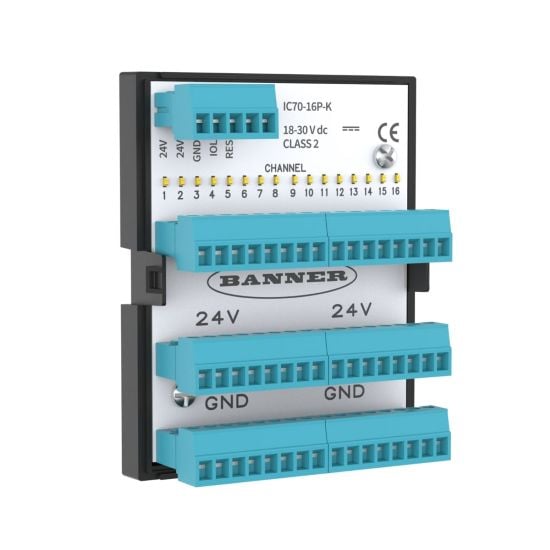
The IC70 IO-Link hub with 16 channels for discrete sensors and actuators. Image used courtesy of Banner Engineering
IC70 Series In-Cabinet IO-Link Hub
When you need I/O on a budget and already have a free IO-Link port, you might want to check out Banner Engineering’s new IC70 series IO-Link hub. The IC70 has 16 channels, each of which can be configured as either PNP input or PNP output. The IO-Link hub is designed to be installed inside of electrical cabinets and is IP20-rated. The housing uses metal screw terminals in a compact and lightweight housing that has DIN rail mounting features.
Special delay modes can be configured for each port, adding additional processing to the PLC logic. Status LEDs are used to reference power, communication, and channel status quickly. Because the hub is IO-Link compliant, parameters can be set remotely through the fieldbus along with diagnostic statuses.
Wiring is made easy thanks to the IO-Link standard; simply connect the five conductors to the nearest IO-Link master and configure your ports for either input or output. Two sets of power and ground terminals are provided for secure and safe wiring.
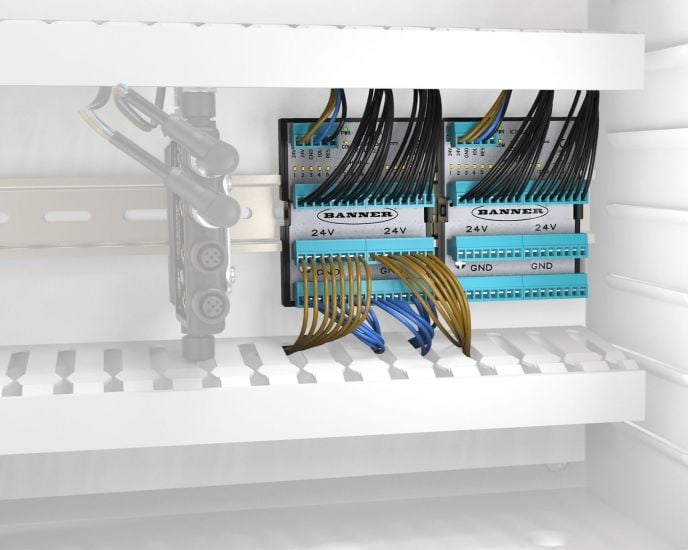
The IC70 IO-Link Hub wired in a control cabinet. Image used courtesy of Banner Engineering
Cost-Effective IO-Link Communication
One major advantage of IO-Link is the ability to plug in hubs into an available IO-Link port and access multiple inputs or outputs that can read positions or drive actuators. Most hubs are designed to be used in the field and are capable of withstanding harsh environments. The IC70 series hub is designed to work in control environments and essentially replace panel I/O. With some PLCs now coming standard with IO-Link masters on the backplane of the controller, it makes sense to look into an IO-Link hub that mounts in the control cabinet.