

Banner has introduced a new line of HF RFID read/write heads and tags designed to improve short-range identification, matching, and traceability in industrial workflows. Operating at 13.56 MHz and supporting IO-Link and Modbus, the devices allow controllers to automatically read stored data without line-of-sight or manual input. Built for harsh environments, the IP67 units offer reliable performance where barcode labels fail, helping manufacturers reduce errors, prevent mix-ups, and maintain cleaner process records.
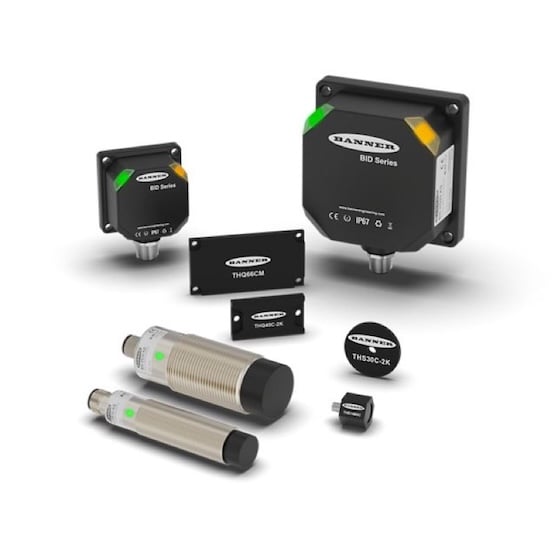
Introducing Banner Engineering’s new HF RFID Read/Write Heads and Tags. Image used courtesy of Banner
Banner’s new HF RFID read/write heads and tags operate at 13.56 MHz with read ranges up to 110 millimeters. The devices also support both IO-Link and Modbus, giving engineers a flexible way to bring short-range identification and traceability into existing control architectures. HF tags store small datasets, such as part numbers, tool offsets, cycle counts, or operator IDs, that remain with the asset throughout its path in the facility. When the tag passes a read/write head, the controller receives the information automatically, with no reliance on optical alignment or manual interaction.
What HF RFID Adds to Industrial Workflows
HF RFID can excel in applications where items move through defined checkpoints. Each tag carries its own data, so the system is not simply recognizing a code but reading the last known state of the tool, part, or carrier. This enables two key functions: matching and traceability.
- Matching verifies that the correct item or operator is present before a process begins, which helps prevent incorrect tool use, misrouted parts, or unauthorized access.
- Traceability builds a time-stamped record of each step, giving engineers a clear view of how components move through a line.
This information can help manufacturing industries by supporting audits, root-cause analysis, and compliance, but it also helps optimize cycle planning and reduce scrap by revealing where deviations occur.
Designed for Real Industrial Environments
RFID equipment often fails when conditions involve vibration, debris, or moisture, so Banner designed the read/write heads with an IP67 housing suitable for demanding production spaces. The product line includes compact cylindrical and rectangular models that fit easily into conveyors, machine frames, staging areas, or tool-access points. The readers work with any HF RFID tag, whether embedded in metal, mounted on tooling, or attached to non-metal surfaces, allowing facilities to mix existing tag inventories with Banner’s options.
With IO-Link or Modbus support, the readers pass tag information directly into the control system, where it can be monitored or tied to machine logic. This makes it easier to maintain accurate process data even when conditions are noisy, dusty, or wet. Since HF RFID does not depend on line-of-sight, it maintains consistent performance in situations where barcode labels degrade or cannot be reliably scanned.
CNC Tool Identification
For CNC systems, HF RFID provides a dependable way to link toolholders to their stored setup data. Each tag retains ID and offset information, which the machine reads automatically when the tool is loaded. This minimizes operator-dependent steps, prevents tool mix-ups, and maintains accurate tool-life data across multiple machines.
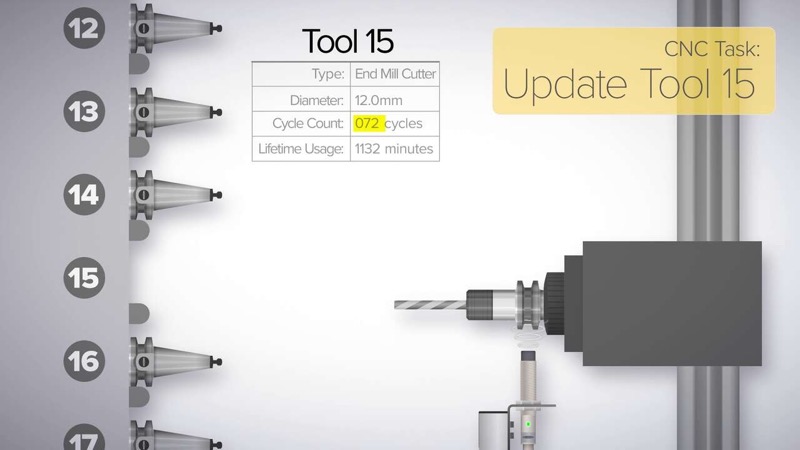
RFID tags can be used to enable automatic identification and usage of tools within a CNC. Image used courtesy of Banner
Short-range data capture plays a bigger role in process reliability than most teams realize. When a system can consistently read and update the information stored on each tag, it becomes easier to prevent mix-ups and follow how assets move from station to station or through everyday tasks. Banner’s HF RFID devices support that function by providing dependable reads in environments where barcodes or manual checks often fail.