
The Automate show offers an invaluable global perspective on robotics and control systems. I always appreciate the chance to learn from subject matter experts and professionals who have graciously invited me to learn more about the applications and solutions presented at the show.
This year, I'm sharing insights from my editorial meetings, focusing on the showcased technology. As we all know, power is a crucial aspect of any system, regardless of size or industry. I was honored to visit with Dean Hutcheson, an Application Engineer from PULS, who educated me about two key product lines: the field power supply (FIEPOS) and the PISA electronic circuit breakers.
PULS FIEPOS: Robust Power and Protection
FIEPOS stands for ‘field power supply’ because it’s a machine-mountable power supply with a protection rating of IP54 or higher. The series also includes many options for electronic circuit protection and network connections.
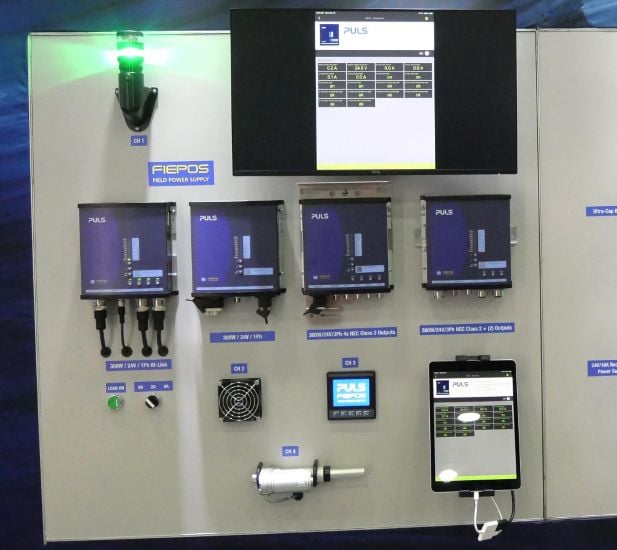
Some of the FIEPOS power modules on display at Automate.
Several versions of the FIEPOS were on display to highlight the selectable, modular nature of the product series. Some of the flexible specs include 1-Ph or 3-Ph power input, various output power ratings, output class ratings, number of outputs varying from one to four, and my personal favorite, the network connectivity.
Since output power limitation is a critical function, the current rating of each output can be configured. Various warning limits and overcurrent trip limits can also be configured. Finally, you can choose between disabling an output by turning it off manually versus disabling an output automatically by trip level. All of this can be done by pushbuttons on the power supply.
But now, here is the fun part: for those FIEPOS modules that are IO-Link enabled, all of the configuration, control, and monitoring can be done remotely. In this demo, a tablet was enabled with the full functionality to demonstrate a simple control system that experienced an overcurrent condition, illustrating the safe shut-off and control of any number of parameters.
PISA-M and PISA-B for Overcurrent Protection
Power distribution can be a space-consuming investment. First, a power distribution block or terminal strip allows power to be routed to branches. Then, a circuit breaker and fuse (usually separate devices) must be attached to each branch in series. Those breakers may be adjustable but usually come with a fixed current rating, carefully chosen for the circuit function.
The PISA electronic circuit breaker series accomplishes nearly all of this in one small device, and even better: it’s programmable!
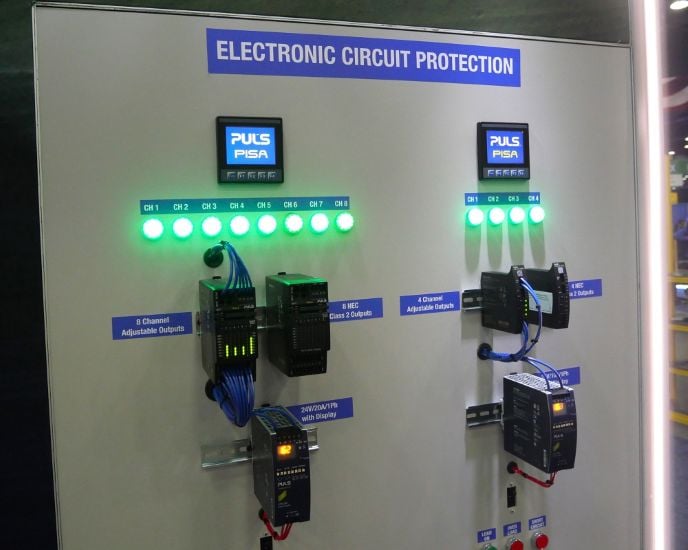
The PISA electronic circuit breaker series.
The PISA-B has 8x adjustable-limit Class 2 outputs, and if you need more outputs, a bus-bar connection on the front can expand the output circuits, provided that the external power supply is sufficient for the task. Simple LED bar graphs show the current set limit and the actual current, with the color changing depending on the overcurrent setting. Like the FIEPOS series, the outputs can also be individually switched on/off with the controls.
Most of the configuration is done by pushbutton, but a digital two-way pulse-code communication allows alarms to be monitored and reset remotely. The flexibility of this system can greatly enhance the responsiveness to power issues around a facility.
Power: Reliability and Safety
Power supplies have always been commercially available at an incredibly wide range of prices, so it’s important to understand why certain specs are so critical: power output, reliability, remote access, not to mention the wide range of overcurrent protection options that reduce the need for other costly equipment inside the panel.