
Pepperl+Fuchs announced two new safety I/O modules, both of which are IIoT-friendly. The modules are similarly built but are available in two variations: the PROFINET / PROFIsafe I/O module and the Ethernet-IP / CIP Safety I/O module.
Both products meet numerous international, industrial safety, and suitability protocols and are designed to simplify connectivity and integration within existing systems. The modules will be available starting in the first quarter of 2026.
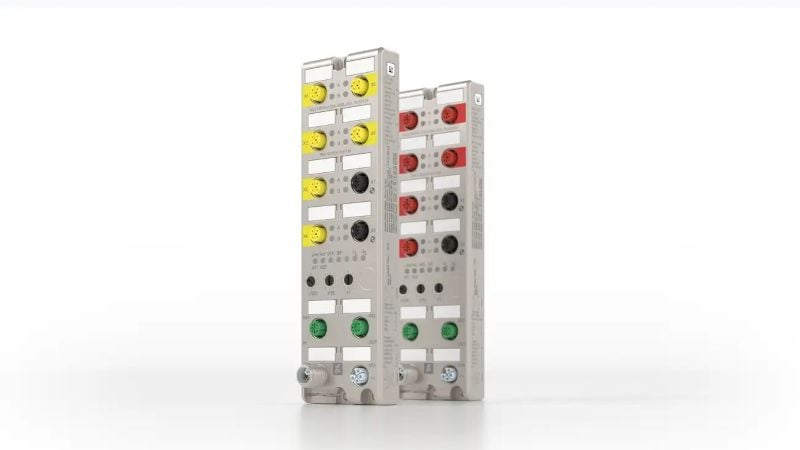
Pepperl+Fuchs will soon be offering two new safety I/O modules: the PROFINET / PROFIsafe and the Ethernet-IP / CIP Safety. Image used courtesy of Pepperl+Fuchs
Safety I/O Modules
Pepperl+Fuchs has designed its two new safety I/O modules to handle safety and standard I/O link data through the same device. Input signals may come from emergency stop buttons, pull cables along conveyor lines, light curtains near robotic cells or machining operations, interlocks for hardware, and other such devices.
The output signals can be used to remove power to motors, contactors, relays, and other hardware to prevent injury during a safety excursion. For example, suppose a picking and packing robot is protected on all sides by light curtains. If a worker accidentally crosses into the machine cell and breaks the light curtain, the robot will stop moving immediately.
Each module features six digital safety inputs and two safety outputs. These modules go a step further and include two standard I/O link ports as well. These ports enable data collection and sending control signals outside of standard safety inputs. Rather than having a separate module for standard I/O, two signals can be easily integrated into the safety system, simplifying wiring and adding flexibility to the overall system.
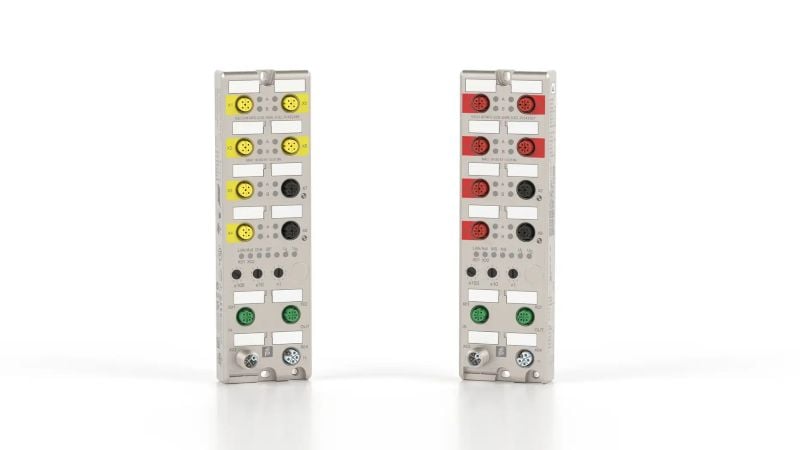
The new safe fieldbus modules feature a zinc die-casting housing and IP67/IP69K protection ratings for use in harsh environments. Image used courtesy of Pepperl+Fuchs
Certified Safety and Protection
Pepperl+Fuchs has designed both modules to meet SIL 3 / PL e international standards for safety. This rigorous standard ensures that the chances of a safety module failure are extremely low (on the order of 1 every 10 million hours of operation). This design also means the modules have internal monitoring mechanisms in place to detect broken wires, shorts, stuck buttons, corrupted communication, and many other criteria.
Besides meeting safety standards, Pepperl+Fuchs has also designed its modules to serve heavy industries. Each module meets IP67/IP69K environmental protection certifications. This protection rating means users can deploy the modules in washing, clean-in-place (CIP), and other environments that are subject to water spray. The modules are even rated for being submerged in water.
Safety in Demanding Conditions
Virtually any industrial or manufacturing facility can improve its safety systems. Integrating a safety PLC system is one such set of engineering controls that adds a passive layer of safety to nearly any process. Pepperl+Fuchs specifically recommends its new modules for robotic cells, conveyor systems, and CNC machining operations, as the modules can help integrate position sensors, emergency stop buttons, pull cables, light curtains, and other such safety hardware.