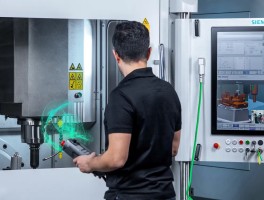

Schunk's new electromechanical clamping devices offer advantages over pneumatic and hydraulic clamps. The new TANDEM clamping force blocks of the KS3 series and VERO-S quick-change pallet modules are battery-powered and utilize IO-Link Wireless. Schunk demonstrated these components at EMO 2025, the production technology trade show that took place at the end of September.
Why Battery-Powered Clamping?
At first glance, battery-powered clamps seem like they will be limited in their applications. However, they provide several key advantages over pneumatic and hydraulic systems. For example, a battery-powered clamp has no awkward hoses or tubing, meaning there is nothing to leak. Pneumatic systems are notoriously leaky, and compressed air is often referred to as the "fourth utility" based on how much gets consumed. Also, the battery-actuated system has no weird or unusual contours or clamping limitations, as it does not have to be limited by the process fluid line routing.
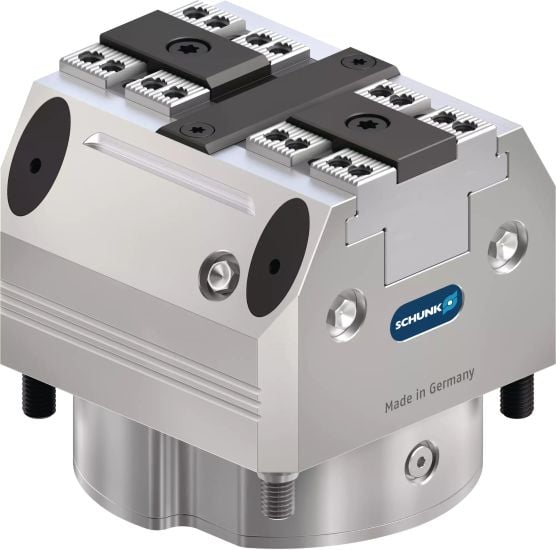
Schunk’s KS3 series of electromechanical clamping force blocks with IO-Link, built for energy-efficient gripping. Image used courtesy of Schunk
By converting a clamping device to battery power, data acquisition is made much simpler. With a hydraulic or pneumatic system, data collection involves running wires, which can become another headache. Because these clamps are battery-powered, the data collection and transmission require little infrastructure to operate.
Electromechanical Clamping Devices
Schunk’s newest electromechanical clamping devices, the KSE3 series of TANDEM clamping force blocks and the VERO-S quick-change pallet modules, are battery-powered and feature IO-Link Wireless. The battery powers both the devices’ clamping actuation and the data collection, then transmits the data along the wireless IO-Link connection.
The IO-Link connection makes data collection and analysis platform independent, and each clamping and unclamping actuation is recorded and accessible to technicians and automation engineers alike. Signal processing occurs within the clamp, so the IO-Link provides the raw data for archival and troubleshooting purposes. Furthermore, thanks to a partnership with Blum Novotest, the devices can also be connected to the popular BRC wireless system. This drastically reduces setup and troubleshooting time.
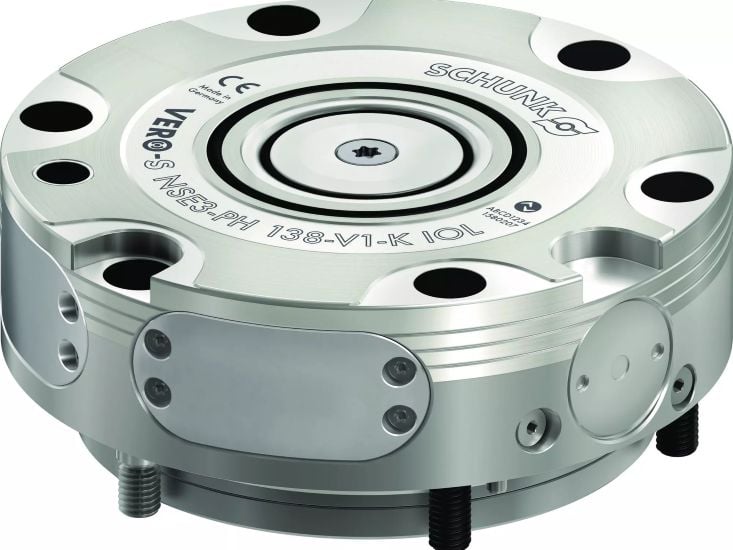
The electromechanical VERO-S quick-change pallet modules are built for simpler installation and greater efficiency than pneumatic and hydraulic-powered alternatives. Image used courtesy of Schunk
Perhaps the obvious question is how the battery-powered devices perform against other traditional clamping systems, such as pneumatic and hydraulic systems. Schunk puts these worries to rest, as the new device provides a powerful clamping force with up to 1,000 clamping cycles per battery charge.
Highly Efficient Clamping
Schunk has designed its new devices to be a less messy, less cumbersome replacement for pneumatic and hydraulic devices for clamping operations. In spite of the name "pallet," these clamping devices are designed to hold workpieces in place during heavy machining operations. Collecting data from the clamp in machining can tell the end user what is happening with each operation.
For example, one problem with manual clamping systems is inconsistent clamping pressure, leading to some work defects or surface damage to the workpiece. Pneumatic and hydraulic systems may also provide inconsistent clamping if they begin to leak. The battery-powered system has the ability to provide consistent clamping and let the user know when the battery is draining so that each workpiece is manufactured identically.