
When it comes to industrial automation, precise and scalable motions are necessary to maintain quality standards and hold tolerance. Achieving precise motion, however, can be challenging, especially with older systems that may lag in responsiveness, struggle with complex multi-axis tasks, and require tedious manual configuration. In fast-paced industries like robotics, semiconductors, and high-speed manufacturing, a split-second delay or a small accuracy error can mean the difference between peak performance and costly downtime.
Elmo Motion Control has introduced the Titanium Maestro, a next-generation motion controller engineered to aid in automation projects that require precise motion control.
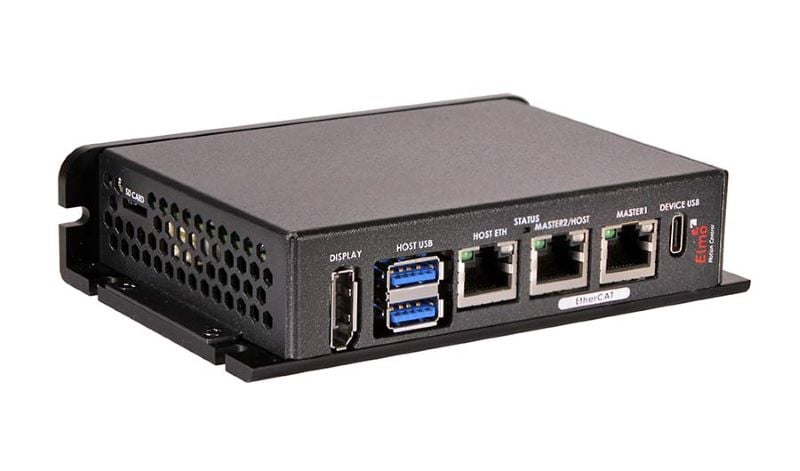
The Titanium Maestro features real-time EtherCAT communication and multi-axis motion control. Image used courtesy of Elmo Motion Control
Titanium Maestro Motion Controller
Elmo built the Titanium Maestro motion controller with a focus on speed, precision, and flexibility. The new controller blends advanced hardware and software into an easy-to-use platform that offers real-time EtherCAT communication and multi-axis management.
At the heart of the Titanium Maestro is a quad-core 1.9 GHz CPU optimized for thermal efficiency with passive cooling with no fans, no noise, and less maintenance. This architecture allows the system to achieve a 100 µs EtherCAT cycle time across 16 axes, enabling precise, synchronized motion, even in highly dynamic applications.
Even though 16 axes are optimized for the fastest cycles, the Titanium Maestro can manage up to 256 axes of motion overall, giving end users the scalability needed for both compact and expansive systems. Engineers designing anything from modular manufacturing cells to full-scale robotic assembly lines can now work within a single, unified control platform.
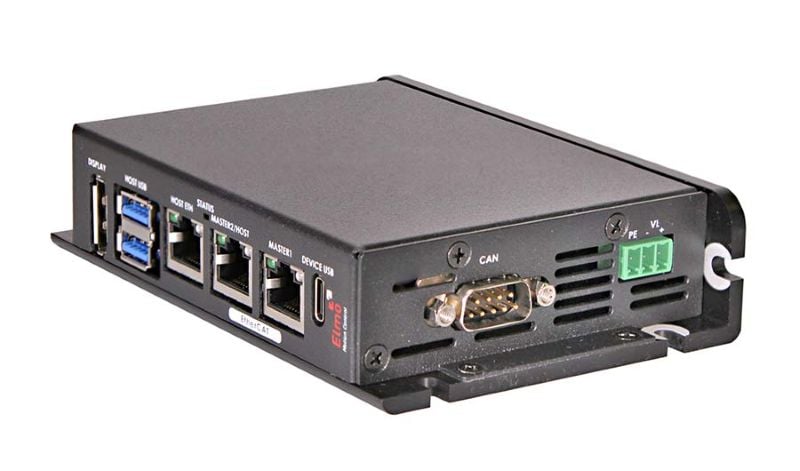
The Titanium Maestro can be programmed with C++, Python, or Blockly. Image used courtesy of Elmo Motion Control
Flexible Programming
Programming flexibility is another of the controller’s features. The Titanium Maestro offers native support for C++, Python, and even Blockly, which is a graphical coding environment that was designed for quickly mapping machine sequences without writing extensive code. Whether an engineer prefers traditional programming or more visual development methods, the platform adapts to different skill sets and project needs.
The controller supports Software-in-the-Loop (SIL) development, which is where engineers can simulate and validate real-time control strategies directly from MATLAB/SIMULINK environments. Meanwhile, the Maestro Web Application (MWA) brings remote access and monitoring right to the user's browser, allowing for visualization, diagnostics, and system tuning from virtually anywhere.

The Titanium Maestro was designed for applications in need of precision motion, from medical and lab to AGV and warehousing. Image used country of Adobe Stock
Multi-Axis Motion Control Management
Titanium Maestro supports TCP/IP, Ethernet/IP, and Modbus protocols, allowing the controller to integrate easily into a variety of industrial networks. Built-in kinematic models support SCARA robots, delta robots, and hexapods, helping manufacturers design complex robotic work cells without needing external computational hardware.
The controller also includes features like polynomial motion planning to ensure smooth and efficient movements by managing jerk and snap parameters. Flying vision technology enables the controller to make real-time trajectory adjustments based on incoming visual data—ideal for high-speed pick-and-place or inspection systems that require split-second reactions. The Titanium Maestro also features network health monitoring, automatic EtherCAT configuration, and 1D/2D/3D error mapping, allowing engineers to diagnose, troubleshoot, and optimize machines with minimal downtime.
For engineers who deal with tighter performance demands, Elmo has designed the Titanium Maestro to keep pace with innovation without adding unnecessary complexity.