
JVL has expanded its long-running MAC motor platform with a new 1500-watt integrated servo designed for 48-volt DC systems. The MAC1403 represents the next step in the company’s cabinet-free motion architecture, a design philosophy that folds the drive, controller, encoder, and communication hardware directly into the motor housing. For machine builders working within tight footprints or thermal constraints, this type of all-in-one architecture offers an alternative to cabinet-based servo systems without sacrificing performance or industrial-grade networking.
The MAC1403 continues the core MAC concept: every major control element is built into the motor. Instead of separating the drive hardware, PLC interface, and networking equipment into a control cabinet, the unit integrates them internally. This structure gives designers more freedom to scale multi-axis systems without increasing cabinet size, and it reduces the wiring required to get a machine running. For applications where cabinet space, heat density, or installation labor are limiting factors, the integrated format changes the way systems can be laid out.
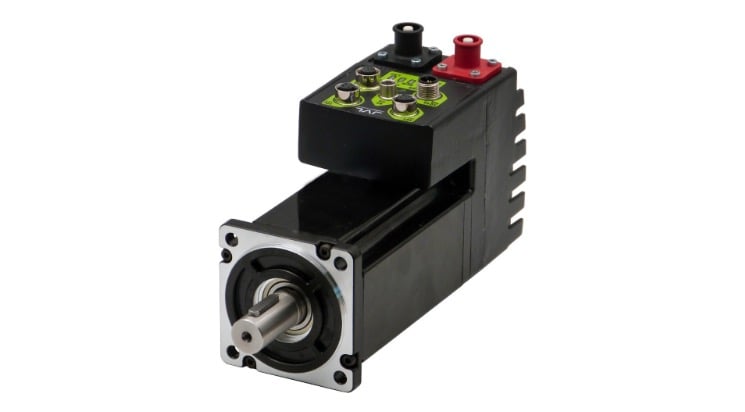
JVL’s new-generation MAC1403 integrated servo motor combines the motor, drive, controller, and encoder in one cabinet-free unit. Image used courtesy of JVL
Integrated Motion Platform With Embedded Control
Like other motors in the updated MAC family, the MAC1403 uses JVL’s ServoStep architecture, which combines a brushless servo motor, a high-resolution encoder, power electronics, and embedded ePLC logic. The controller can run stand-alone sequences, respond to PLC commands, or be configured directly from a host controller using standard function blocks. The eight onboard I/O points can be configured as digital or analog channels, enabling the motor to handle localized sensing, simple feedback logic, or auxiliary actuation without external modules.
This level of integration is possible because the new MAC series consolidates internal boards, reducing layout complexity and improving long-term reliability. JVL states that the motors are engineered for continuous 24/7 duty with a minimum 10-year operational lifespan. High-efficiency components and optimized thermal paths limit heat buildup inside the motor body, a crucial factor for delivering peak torque. For example, the MAC1403 delivers 4.78 Nm of peak torque while maintaining stability under load.
Ethernet-Centric Connectivity With Daisy-Chain Switching
Network integration has been one of the defining traits of the MAC platform, and the new generation reinforces that approach. The MAC1403 supports the full range of industrial Ethernet protocols: Profinet, EtherNet/IP, EtherCAT, SERCOS, Powerlink, and Modbus TCP/UDP. Instead of relying on external switches or network modules, the motor includes a built-in Ethernet switch, allowing daisy-chain wiring between axes. With a single cable run between motors, multi-axis systems become cleaner, easier to extend, and less dependent on cabinet hardware. For applications that still rely on CAN-based architectures, the motor can also be ordered with CANopen support compliant with DS301 and DSP402.
Because Ethernet communication is embedded rather than handled by plug-on modules, the motor now receives protocol updates via firmware. This shift away from hardware plug-ins reduces cost, streamlines configuration, and reflects JVL’s long-term pivot toward Ethernet-first systems.
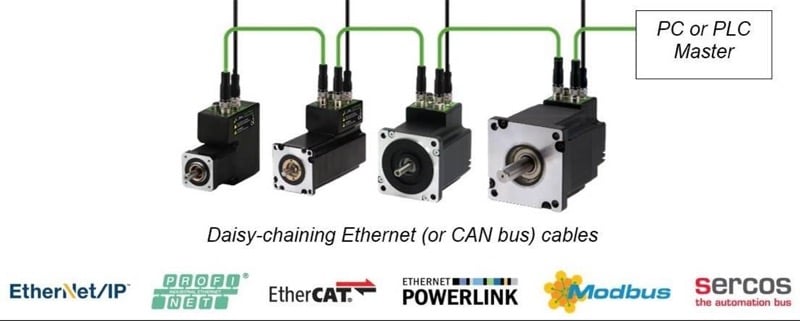
Built-in Ethernet switching allows MAC motors to be daisy-chained for multi-axis systems using protocols such as EtherCAT, EtherNet/IP, Profinet, Powerlink, Modbus TCP, and SERCOS. Image used courtesy of JVL
Options for Advanced Feedback and Safety
The MAC1403 can be equipped with a multiturn absolute encoder that tracks position without batteries or external power. For machines requiring safety-rated performance, the motor offers STO (Safe Torque Off) meeting SIL3 safety standards. This function disables torque output at the drive level, providing a direct safety channel without needing additional relays or cabinet-mounted safety hardware. Gearbox options, such as planetary, worm, and hypoid units, expand the range of mechanical configurations, enabling the motor to support both high-torque and high-speed applications.
Cabinet-Free Architecture for Flexible Machine Design
The defining characteristic of the MAC1403 is its cabinet-free installation. By removing the drive hardware from the control cabinet entirely, the motor helps reduce cabinet heat, simplify cooling requirements, and cut overall machine cost. Machine builders can design systems around a single small control cabinet rather than a large one sized around multiple servo drives.
This approach also improves scalability. Adding axes no longer means reserving cabinet space, installing additional drives, or expanding power distribution blocks. Instead, new motors are mounted directly on the machine frame and connected through power and network lines, a model well-suited to modular equipment, packaging systems, robotics, and automated vehicles.
Built for Fast Development and Easy Integration
JVL’s MacTalk software provides commissioning tools across the entire MAC range, while Siemens TIA function blocks and Rockwell AOIs allow direct integration into mainstream automation platforms. The embedded ePLC enables quick axis testing during prototyping without wiring a full PLC program, which is particularly useful in automotive and industrial automation environments where rapid iteration is standard practice.
Because the new MAC series emphasizes firmware-driven expansion rather than hardware plug-ins, development cycles are faster, and maintenance overhead is lower. Self-diagnostic features help monitor performance and catch issues early, reducing downtime and making the motors easier to support over long service lives.
A Higher-Power Addition to the MAC Family
The MAC1403 fills the upper range of JVL’s DC-powered portfolio, extending the 24-48 VDC line to a full 1500-watt continuous output with peaks up to 4.5 kW. It fits into the same strategy as the earlier models, a compact integrated servo platform intended for OEMs that want high performance without the space, heat, and wiring burden of traditional servo systems.
As machines continue to shrink, decentralize, and push complexity out of the cabinet, the MAC1403 gives designers a path toward simpler architectures without compromising capability. The new generation of MAC motors marks a significant step forward in cabinet-free motion control, combining integrated control, Ethernet-centric networking, and a proven mechanical platform.