
With the ever-expanding market for bigger, better, and faster machining technologies, Renishaw, a global engineering technology group that specializes in high precision technology for metrology and healthcare, has enhanced their FORTiS enclosed encoder lineup by increasing their linear scales to reach as long as 4.24 meters. The encoder is designed for use in harsh environments.
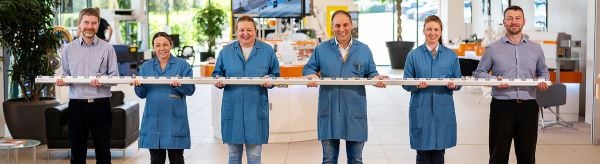
The FORTiS absolute encoder can be purchased in lengths of up to 4.24 meters. Image used courtesy of Renishaw
About the FORTiS Lineup
The FORTiS enclosed linear absolute encoder is specifically designed for larger machines, particularly vertical turning lathes (VTLs), large gantry-type machines, and large casting applications like giga casting. The system is valuable for higher precision and cost control in specialty applications, and it is particularly useful for dual ram systems that enable both turning heads to utilize the same scale, simplifying mechanical design while enhancing machine quality.
Renishaw offers two extrusion profiles in the FORTiS system: the FORTiS-S linear encoder and the FORTiS-N encoder. The FORTiS-S comes in lengths ranging from 140 mm to 4240 mm and is the standard-size encoder designed to be directly installed onto a machined surface using flexure holes in the extrusion's body.
On the other hand, the FORTiS-N is available in lengths from 70 mm to 2040 mm and is designed to be attached to a machined surface using two end cap mounting holes or a mounting spar. The FORTiS-N has a narrower cross-section and a more compact design, making it suitable for tight spaces.
The absolute linear encoders utilize Renishaw’s RESOLUTE encoder technology and undergo rigorous quality control processes certified to ISO 90001:2015. The encoders feature extruded enclosures with interlocking lip seals and sealed end caps. The redhead body is connected to a sealed optical unit by a blade that travels through DuraSeal lip seals along the length of the encoder, making the FORTiS encoder suitable for operation in extremely harsh environments.
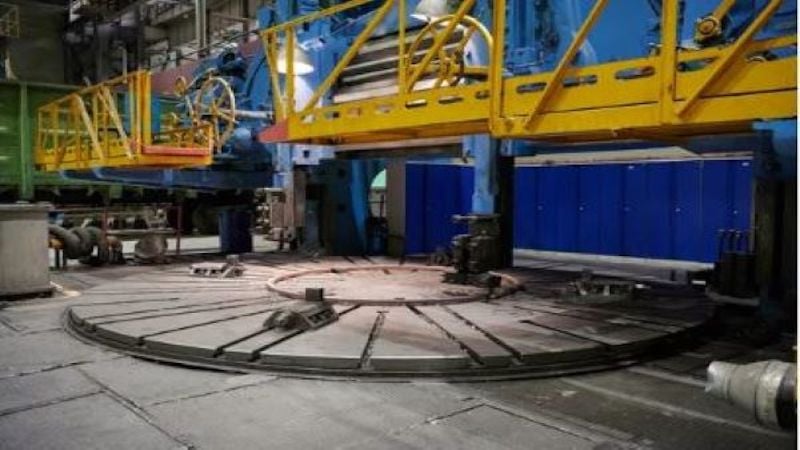
In multiple industries, vertical turning centers can exceed diameters of over 100” and require high-precision machining. Image used courtesy of Adobe Stock
Real World Applications
In various global industries, there is a demand for large-scale components that often go unnoticed by the general public. The bearing industry serves as a prime example. While most individuals associate bearings with small-scale applications like those found in skateboards or car wheel bearings, the oil and gas, as well as energy sectors, require bearings that can exceed 60 inches in diameter. Machining such large components necessitates using specialized equipment such as vertical turning lathes, which must achieve precision levels of less than one-thousandth of an inch in certain circumstances. These VTLs produce equipment used in mining, fracking, or even windmills.