
Aaeon has introduced the OMNI-ADN series, a range of modular human-machine interface (HMI) panel PCs. Built on the Intel Processor N-series (N50 and N97), the series is a lower-power, scalable alternative to higher-end HMI systems. The OMNI-ADN platform is designed for industrial environments, with features that support a range of machine control and monitoring tasks.
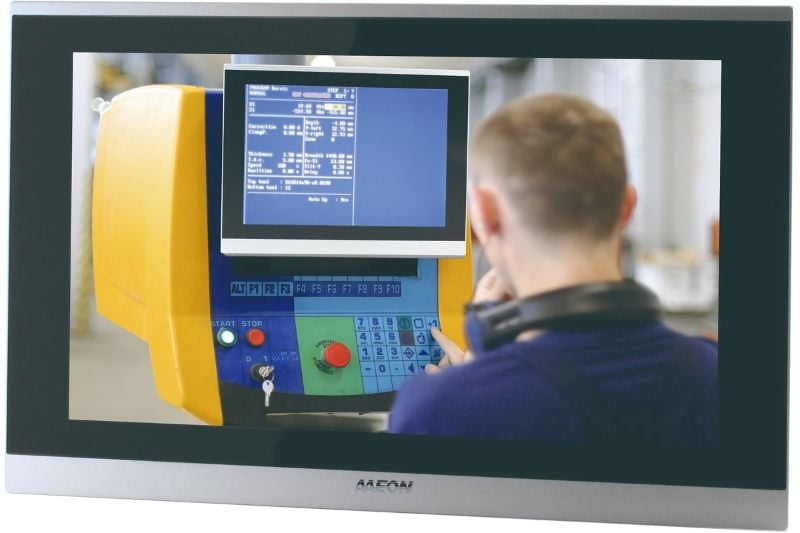
The OMNI-ADN series of HMI panel PCs feature a modular design that enables users to upgrade parts or scale up display size when needed. Image used courtesy of Aaeon
OMNI-ADN Series HMI Panel PCs
The OMNI-ADN series HMI panel PCs include a modular design, separating the display and computing components. This design enables interchangeability between display sizes and processor configurations, giving users greater flexibility while reducing hardware variation across projects. For machine builders, modularity means a single computing core can be used across machines with different operator interface requirements, helping to simplify both maintenance and post-installation support.
The OMNI-ADN models can operate within a -20 °C to 50 °C temperature range and support a 9 V to 30 V DC input. These parameters make the units compatible with various industrial power systems and suitable for deployment in environments that experience moderate temperature fluctuations.
The systems are passively cooled, which reduces failure points and maintenance requirements related to dust accumulation. This is important for sealed enclosures or applications in dusty or oily environments, such as food processing, metalworking, or woodworking facilities.
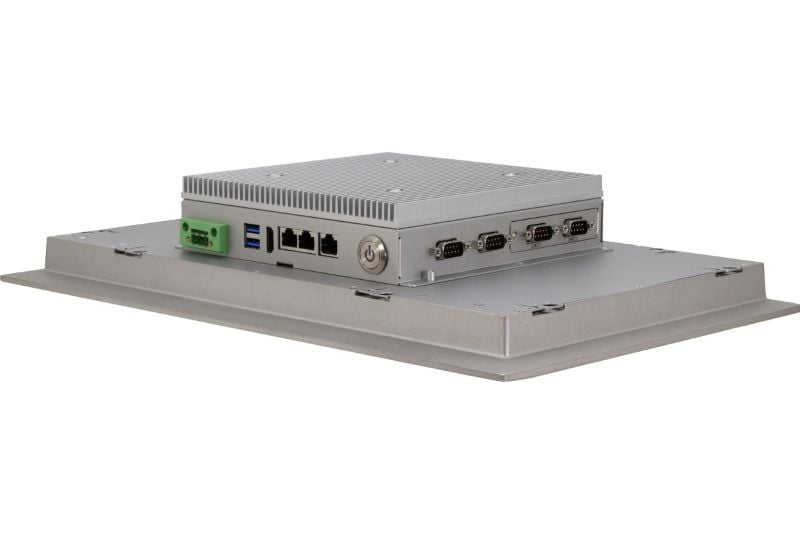
The OMNI-ADN HMI panel PCs feature DB-9, RJ-45, USB, and HDMI ports. Image used courtesy of Aaeon
Connectivity and Networking
For connectivity, the OMNI-ADN series includes dual DB-9 serial ports (RS-232/422/485), three 2.5 GbE RJ-45 Ethernet ports, two USB 3.2 Gen 2 connections, and an HDMI output. The dual DB-9 ports support communication with PLCs, motor drives, and industrial sensors.
Multiple Ethernet ports allow the HMI to function as a bridge between internal control networks and higher-level IT systems. The HDMI port may be useful in setups that require an auxiliary display for diagnostics or operator viewing at a remote location.
The OMNI-ADN series supports wireless expansion through M.2 3052 and 2230 slots, with the ability to install 5G, Wi-Fi, and WWAN modules. This makes the OMNI-ADN units viable for applications where remote access, data logging, or cloud integration are required. With increasing interest in edge computing and IIoT, this flexibility enables the panel PCs to take on roles beyond user interface, such as acting as lightweight data collection or analysis nodes.
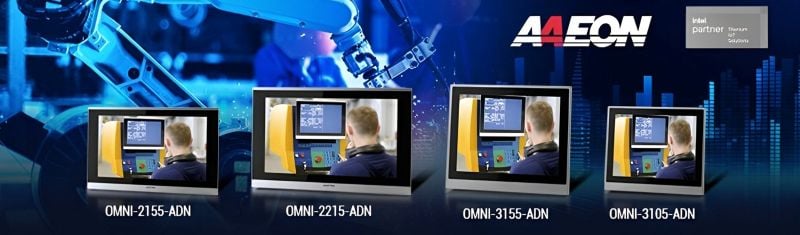
The OMNI-ADN series is available in four different screen sizes ranging from 10.4 inches to 21.5 inches. Image used courtesy of Aaeon
PCAP Touch Screen and Display
The OMNI-ADN series is available in 10.4-inch, 15-inch, 15.6-inch, and 21.5-inch sizes, covering most typical HMI needs, from compact control stations to more detailed process displays. All models use projected capacitive touch (PCAP) technology with wide 178° viewing angles and around 90% light transmission. These displays support multitouch and remain visible even at oblique angles, which is ideal for factory environments where operators often move.
Industrial Display Solutions
Using Intel N50 and N97 processors places the OMNI-ADN series in the entry-level to mid-range computing class. The CPUs are designed for low power consumption while still supporting typical HMI applications, such as data visualization, basic SCADA interfaces, and control panel interaction. Compared to Aaeon’s earlier OMNI-ADP models (which use 12th-generation Intel Core processors), the OMNI-ADN series is likely better suited to cost-sensitive or low-power applications where advanced processing is not required.